Thursday, January 28, 2016
IRB Intro #3
For my third IRB, I am going to read One Man's Wilderness, a story of a man who journeyed to Alaska and made a life for himself. I chose this book because I think that Alaska is beautiful, and maybe one day I would like to live there, too. I look forward to reading it, and hope to learn a lot about the life he lived in beautiful Alaska.

Sunday, January 24, 2016
TOW #16 - IRB
Four Seasons in Rome is one of the most powerful examples of a memoir, a year in the life of Anthony Doerr, an incredibly gifted artist who spends the entire year trying to understand, and failing, the intense complexities of Rome. Anthony Doerr uses vivid imagery and meaningful anecdotes in order to effectively explain his emotions and life when living in Rome. When trying to convey the wonder the city imparts on people, he shows an example of people from Northern Italy who cannot begin to understand the complexities of the city, see: "Far below us is the dark saucer of the Pantheon, the blue tourist balloon at the Villa Borghese, the Vittoriano, the clusters of rooftops: the city... "Ecco Roma!" Here is Rome" (Doerr 195). Again, the power of words are utilized by Doerr. He shows the wonder that the city instills, the beauty of the whole thing, and how in love it makes people feel. Examples like this show how the city imparts itself on it's visitors, how insanely in love it makes them feel. To describe the experiences he feels every day, Doerr says: "At noon Shauna and I sit in the garden eating mozzarella, tomato, and vinegar sandwiches. The breeze is mild. The boys stagger beneath the trees nearby and pick up fallen apricots and occasionally bite into one" (Doerr 191). This little yet beautiful glimpse into the life of Doerr grants the reader an understanding of what he feels, what he does, what he loves. It makes them feel like they are with Doerr, enjoying Rome with him. I would find myself lost in the sea of his description, daydreaming about the beauty aforementioned. Then I knew Doerr was successful, as he truly conveyed how lovely and life altering the experience was to his reader.
Monday, January 18, 2016
TOW #15 - Graphic

Sunday, January 10, 2016
TOW #14 - Printing Money
To avoid economic stagnation faced by nations like Japan, John Cassidy, who is an esteemed economist journalist, suggests that the US should print money and hand it out to it's citizens. He argues this radical viewpoint with logical reasoning and analogies to convince the reader that his unorthodox idea is the best solution. "helicopter drops, or their electronic equivalent, could provide the Japanese government with a way to lift its economy out of a decade-long slump." (Cassidy 2). Money would be injected into the economy, and activity would explode, leading to a stronger and healthier economy. This idea, at least to many people, would have the opposite effect, but Cassidy uses facts and logic like this to prove them wrong. The economic issue can be solved by printing money, and this story shows the side of one that far too many people neglect. This devil's advocate is not totally out of his mind, and offers the insightful perspective of the opposing design. The author also uses analogies to strike fear into the hearts of the reader. When reading about Japan, the reader will most certainly not want the United States to experience the economic stagnation that they are subject too, so the reader may consider actively trying new and innovative economic methods. The author was overall quite successful. I went in strongly against this idea, not for any good reason that he did not disprove in the text. The convincing nature of the article makes you want to sink in and accept the unique idea instead of utterly rejecting it out of closed minded fear. By opening the perspective of the reader, he has completed his cause. The author never wanted to hand out thousand of dollars, but wanted to find a better medium in between what our current system is. This method can truly revitalize the economy.
Sunday, December 20, 2015
TOW #13 - The Fear of Islam in Tennessee Public Schools
Williamson County, Tennessee, a predominantly white county north of Nashville, many parents fear that by educating their children about Islam, teachers are indoctrinating them into the religion. They feel that teachers preach pro-Islam tendencies and mostly bad things about Judaeo-Christian religions. They want the textbooks to stop calling Islam a peaceful religion, and teach them about the few extremists instead. Emma Green, author of The Fear of Islam in Tennessee Public Schools, seeks to prove these people wrong with logical reasoning and by mentioning sudden hints about the groups who support the cause. When talking about the county, Green calls the idea of kids being indoctrinated into Islam most impossible by saying that the county is: "overwhelmingly white, Christian place like Williamson County" (Green para 7). By using logic, she proves the irrational people against her wrong, simply by showing that the environment around kids that would be "indoctrinated" would not be hospitable to them in any way, shape, or form. Throughout her essay, the author mentions Glenn Beck and Pat Robertson, people who are largely against Islam and any non Judaeo-Christian in every way, when describing who is fighting against this "indoctrination". These names leave a sour taste in the mouth, a reminder of the hugely conservative and very hateful roots of this movement. This fact alone would probably turn away people in disgust, as these men listed invoke feelings of distrust and malignment. Thus, the reader is already turned against the parent's of Tennessee's cause. These are the nails in the coffin, they are what makes the author successful.
Saturday, December 12, 2015
TOW #12 - IRB: Four Seasons in Rome
Four Seasons in Rome by Anthony Doerr is not a simple and generic tale about the love of a romantic city. It as about his growth with Rome, his discovery of the city and then a discovery of himself. Anthony Doerr was chosen by an Academy in Rome to have a fellowship to live on Rome in a year. He wanted to describe his experience in the city and how he grew here by writing Four Seasons in Rome. Doerr used powerful imagery and deep anecdotes in order to show how powerful the city of Rome is and how it transformed him as the person. "It tastes like nutmeg and brine and cream; we eat slices as if it were cake" (Doerr 39). His culinary tastes grew in Italy, as well as the rest of him, too. The experiences he has illustrate the changes in his lifestyle, how the beauty of Rome transformed him as a person. This illustration showed how powerful the experience was for him, and how deeply it affected his existence in no other way other rhetoric will not. Doerr also used anecdotes to show how he grows too. When he describes how he adjusts to the age of the city, "The oldest building in Idaho... built by... 1853... The oldest building in Rome with its original roof still intact is the Pantheon... by the emperor Hadrian around AD 125" (56-57). When explaining how he ponders the descriptions of time, he juxstaposes the age of the Pantheon with the oldest building in Idaho, adeptly showing how the definition of our time is so brief without truly saying it, and this shows the reader how Rome changes one's opinion about the world. He says what he wants to say through experiences, not by the words that we typically do. That is the power of imagery and anecdotes.
Saturday, December 5, 2015
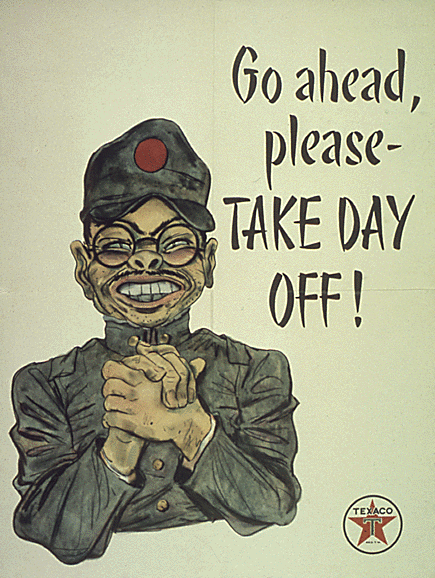
TOW #11 - Go ahead, please - TAKE DAY OFF!
Subscribe to:
Posts (Atom)