Sunday, December 20, 2015
TOW #13 - The Fear of Islam in Tennessee Public Schools
Williamson County, Tennessee, a predominantly white county north of Nashville, many parents fear that by educating their children about Islam, teachers are indoctrinating them into the religion. They feel that teachers preach pro-Islam tendencies and mostly bad things about Judaeo-Christian religions. They want the textbooks to stop calling Islam a peaceful religion, and teach them about the few extremists instead. Emma Green, author of The Fear of Islam in Tennessee Public Schools, seeks to prove these people wrong with logical reasoning and by mentioning sudden hints about the groups who support the cause. When talking about the county, Green calls the idea of kids being indoctrinated into Islam most impossible by saying that the county is: "overwhelmingly white, Christian place like Williamson County" (Green para 7). By using logic, she proves the irrational people against her wrong, simply by showing that the environment around kids that would be "indoctrinated" would not be hospitable to them in any way, shape, or form. Throughout her essay, the author mentions Glenn Beck and Pat Robertson, people who are largely against Islam and any non Judaeo-Christian in every way, when describing who is fighting against this "indoctrination". These names leave a sour taste in the mouth, a reminder of the hugely conservative and very hateful roots of this movement. This fact alone would probably turn away people in disgust, as these men listed invoke feelings of distrust and malignment. Thus, the reader is already turned against the parent's of Tennessee's cause. These are the nails in the coffin, they are what makes the author successful.

Saturday, December 12, 2015
TOW #12 - IRB: Four Seasons in Rome
Four Seasons in Rome by Anthony Doerr is not a simple and generic tale about the love of a romantic city. It as about his growth with Rome, his discovery of the city and then a discovery of himself. Anthony Doerr was chosen by an Academy in Rome to have a fellowship to live on Rome in a year. He wanted to describe his experience in the city and how he grew here by writing Four Seasons in Rome. Doerr used powerful imagery and deep anecdotes in order to show how powerful the city of Rome is and how it transformed him as the person. "It tastes like nutmeg and brine and cream; we eat slices as if it were cake" (Doerr 39). His culinary tastes grew in Italy, as well as the rest of him, too. The experiences he has illustrate the changes in his lifestyle, how the beauty of Rome transformed him as a person. This illustration showed how powerful the experience was for him, and how deeply it affected his existence in no other way other rhetoric will not. Doerr also used anecdotes to show how he grows too. When he describes how he adjusts to the age of the city, "The oldest building in Idaho... built by... 1853... The oldest building in Rome with its original roof still intact is the Pantheon... by the emperor Hadrian around AD 125" (56-57). When explaining how he ponders the descriptions of time, he juxstaposes the age of the Pantheon with the oldest building in Idaho, adeptly showing how the definition of our time is so brief without truly saying it, and this shows the reader how Rome changes one's opinion about the world. He says what he wants to say through experiences, not by the words that we typically do. That is the power of imagery and anecdotes.
Saturday, December 5, 2015
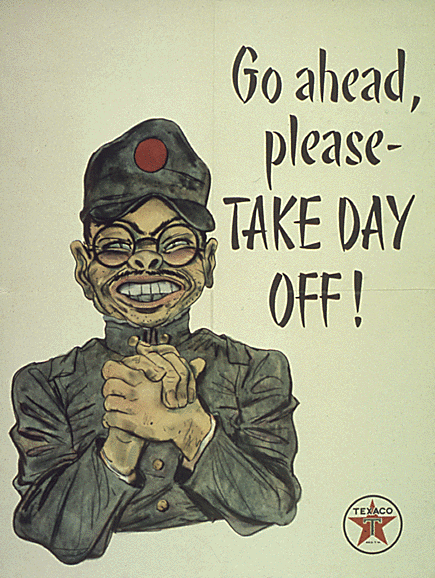
TOW #11 - Go ahead, please - TAKE DAY OFF!
Sunday, November 22, 2015
TOW #10 - Why Affluent Parents Put So Much Pressure on Their Kids
To many children who have affluent parents, the force behind them telling them to succeed can overcome them. A constant pressure to be perfect, to build an amazing resume, to get into what seems to be a smaller pool of colleges and universities can cause all sorts of issues for these kids. Many develop mental health disorders due to all of the stress, and some even turn to suicide. Why Affluent Parents Put So Much Pressure on Their Kids, written by Rebecca Rosen, a business writer who understands the high pressure environment pushed on to their kids, examines why this is the case. In her piece, Rosen uses paradoxes and logical reasoning to show why rich kids are faced with such intense stress. Rosen starts her piece by saying: "With financial success ought to come some measure of relief..." (para 1), and then spends the rest of the essay disproving this. She introduces the piece with a paradox to address the misconception that many affluent kids have an easy life. Rosen also uses logical reasoning to show why these kids are stressed. If you’re a doctor, lawyer, or MBA—you can’t pass those on to your kids." (Para 5). This shows why many kids have to work so hard in high school, so that they can maintain the way of life their parents had. It also shows the limits of wealth in helping kids succeed, as it can only do so much and kids have to contribute a great deal to their own success. This essay is successful, as it educates the reader about the pain that affluence afflicts on students. As a child of two JDs, I find this piece hard hitting, it could not be more right. I never have to worry about my material possessions at the moment, but the stress from all of the work I need to do to keep this way of life is incredibly taxing.
Sunday, November 15, 2015
TOW #9 - Paris and the Lessons of 9/11
We stand for the Tricolore. We stand for Justice. We Stand With Paris. Nous sommes tous Français. However, we must learn from their actions when supporting us in the past. They served as our anchor of logic when we were about to start the war in Iraq. They did not support the war because they believed it to be rash and thought that rage clouded our judgement. Now, in France's time of trouble, Americans rally with them to hopefully crush the source of terror, ISIS. The author wrote this article to have us learn from the past, and hopefully be a logical anchor to stop any rash decisions by the French Government in their time of need. Graduate of Pomona College and New York University Conor Friedersdorf calls for the US to be an ally to France in his article Paris and the Lessons of 9/11, but at the same time reminds us to be tactful with our alliances and convinces the reader to follow this train of thought with hard hitting historical evidence and a careful diction that builds ethos. He reminds the reader very carefully that he is for solidarity with France, just not complete agreement by saying: "I endorse the widespread affirmation of solidarity with the French" (para 3) and continues his point by saying: " good allies engage in constructive criticism as best they can" (9). He reminds us that we should support our ally, and then tells us that challenging them is perhaps the best thing an ally can do, as it is for their benefit, not us being evil to them. He also uses hard hitting historical evidence to show the need for a logical anchor. "a majority of Americans began to conclude that Saddam Hussein posed an uncontainable threat, our allies in Paris insisted that our trauma was clouding our judgment" (4). We fell into a trap that France warned against, but they were being good allies by reminding us to not be so rash. This also hits home to Americans, as many see the Iraq War as a mistake, and France's foresight will perhaps make people want to reciprocate this kindness. The careful diction that leaves the reader open to Friedersdorf's ideas and the relatable historical evidence converts the reader to want to make the US a better ally to a struggling nation. The delicate subject was handled with rhetoric, and the author was so successful in doing so.
Monday, November 9, 2015
IRB Intro Post #2
For my second independent reading book, I will be reading Four Seasons in Rome by Anthony Doerr. I chose this book because it follows a man and his journey in the wonderful city of Rome, and is a different way to romanticize a European city. I think it will give me a perspective on living abroad, and perhaps encourage me to make a similar journey.
Sunday, November 1, 2015
TOW #8 - IRB: My Beloved World
My Beloved World is a profound story of triumph unlike any ever released before. Sonia Sotomayor painted such a meaningful and rich picture with the story, and defined herself and her experiences through it. In My Beloved World, Sonia Sotomayor uses powerful anecdotes in order to define her life and her principles, too. Every experience she included had meaning, from advocacy at Princeton to struggles at Yale Law to triumph on the bench, every piece of the book conveyed her principles, and captured her essence as well. Sotomayor starts the second half describing her activism for minorities in general at Princeton, continues to explain her marriage, then provides stories from her days at the challenging Yale Law School. Then she can be found in the New York District Attorney's Office, skillfully making moves from misdemeanor department up to the felony department and even having a homicide case. She then found herself getting a job from a posh international law firm in Midtown, succeeding in every imaginable situation she found herself in. When she was finally nominated to become a judge by a national senator, she saw her dreams being realized, and the power of this moment will be immortalized in this book. The anecdotes in this story show the morals and ideals that she values more effectively than just blatantly stating her thoughts. For example, when talking about the rigors of law school, she said that: "Even a correct answer could lead to further probing that might leave you looking for a hole to crawl into" (Sotomayor 218). She later explains that this would shape her into a successful lawyer as it would teach her the pressure she would have to operate under. Her story of anguish was included for a reason, as it shaped her being. Every piece included in the book shaped Sotomayor, so all of it helped her to achieve her purpose and made the book so interesting. Few people are like Sotomayor, and her one of a kind biography exemplifies this.
Subscribe to:
Posts (Atom)